Showing posts with label game review. Show all posts
Showing posts with label game review. Show all posts

You may recall that last year I picked up Divinity 2: Ego Draconis and considered it 'one-third of an awesome game.' I was thrilled to read about the Flames of Vengeance expansion that would supposedly finish the story of the Dragon Knight.
Flame of Vengeance was to arrive in August but got pushed to November. It then came out as part of the Dragon Knight Saga, which is a graphically enhanced version of Ego Draconis and the expansion bundled together. As far as I can tell, there's no way for owners of the original game to simply buy the expansion pack, but Dragon Knight Saga is only $39.99.
After instillation, I attempted to load up my last save so I could jump into Flames of Vengeance, but the game says my old saves are all 'wrong version.' I can create a fresh, high-level character for FoV, but I might as well replay the original game. It's been almost a year but I do recall I wanted to try out something other than the basic melee build I originally used.
Unfortunately, the 'enhanced graphical engine' still gives me a black screen when I pick my PC's native 1680x1050 resolution and attempts to reset to 640x400. My video card doesn't even support that. Why in the world would a modern game even acknowledge the existence of such a screen resolution?
I do what I had to do in the first game and open: C:/Users/LSN/AppData/Local/Divinity2/Profile/graphicoptions.xml
And manually set my resolution.
The game doesn't support screen capture, so it's FRAPS time.
Despite my issues, I will say that the game itself is already faster. In the original, the main menu would appear and then I'd have to wait 15-30 seconds before I could interact with it. The time to load the character creation screen is also faster.


 This is part two of a two-part review of Mirror’s Edge and contains many spoilers. Read Part 1 for general thoughts.
And here is where I get nitpicky, mostly about the story of Mirror’s Edge.
Mirror’s Edge’s gameplay is good. It’s smooth, responsive, and the blend of puzzle and combat sections (they’re more racing sections as the eight times out of ten you’ll want to avoid combat) work. The bright environments would have been a great set up for grungy, darker environments later on, but that instead we’re treated to grungy, darker cartoons that aren’t all that interesting.
I can buy into the premise of a totalitarian regime taking control of a near future, first-world nation and using the tools we currently associate with informational freedom (the internet, e-mails, video systems) and using them to monitor and control the populous while replacing news systems with propaganda. Runners are one way that people have learned to get around that scrutiny.
The story itself engages in little political or social thought. Strange for a game that’s premise is so political. Faith seems indifferent to the world around her in anything but the most basic level: She runs because Merc taught her to. She investigates the assassination of a politician because her sister is framed.

This is fine; Faith is not required to be an intellectual character. Though I’d be interested in learning her thoughts regarding government power, citizen responsibility, and the tension between keeping a society safe and keeping it free, this is Faith’s game, and these topics never appear to enter her stream of conscious.
Okay then, perhaps Faith is more of an intuitive or emotive person. The cartoons suggest she’s a ‘survivor’ who’s learned to evade the law and make it on the streets at a very young age. This is a great beginning for a story, but it’s not enough. A good story has the main character changing in some way.
This is why Prince of Persia: Sands of Time is one of the best stories in gaming. In the beginning, the Prince is arrogant, ambitious, and obsessed with earning honor and glory. His actions lead to death/corruption of those around him, including his beloved father (and possibly the corruption of the world, but that’s not the central issue for him.) Throughout the game, he learns humility, he learns to take responsibility for his actions, and he learns to trust others and put them first.
Fiction 101: the protagonist goes through a series of challenges in pursuit of a goal that changes them for better (Prince of Persia) or worse (Scarface.)
Video games have gotten away with ‘Aliens/demons/Nazis attack, you fight them and win!’ for a long time, but Mirror’s Edge is trying hard to be something unique. The bits between chapters are obviously attempts to make Faith and the story’s events more meaningful than ‘Police attack, you run/fight them and win, ‘ but that attempt is a failure.
When Kate, Faith’s sister, is revealed I was thrilled. She’s one of the ‘Blues,’ the police that are the runner’s main advisory. I suspect Kate is a lawful good paladin; when faced with a government that robs people of their freedoms and a corrupt police force, she joins the police and tries to be one of the good guys. I think the story as-is would be better told with her as the main character: she’s a good cop framed for the murder of a rising politician. While running from the law, she uncovers a plot to take over the city, and ends up working with ‘criminals’ she once fought in order to make sure the current Mayor doesn’t replace the police with a private army he owns.
When Faith first leaves Kate, she urges her sister to come with her. To run from the police about to enter the building, arrest Kate for assassination, and find her guilty in a mock trial. Kate’s response? She’s staying there. Faith will run, Faith always runs, but Kate will stand.

And, when you have a story about oppression, then you need a character who will stand for something. Faith never becomes this person. She runs, and saves her sister, but she seems as unconcerned with the bigger problems of the world and the events that led her sister to being wrongfully imprisoned, as she is when the game starts.
“I love my sister and would do anything to save her’ is touching, and a great starting point for the story, but it’s not enough.
This is part one of a two-part review of Mirror’s Edge and contains no spoilers while part two refers to specific events and situations within the game. Last night I finished Mirror’s Edge, and I have to say it was an exquisite experience. From the visceral gameplay to the bright, bold aesthetic, from the electronic soundscape to the heroine herself, Mirror’s Edge take us out of the realm of business as usual when it comes to video games.
This isn’t to say that the game lacks flaws. My emotional landscape was like this as I played: Pleasure of discovery –> Comfort as I settle into the game –> Frustration as I am pulled frequently out of it –> Disappointment as the game’s weaknesses mount –> Focus as the intensity and difficulty rises –> And finally, satisfaction as I reach the end. In many ways, the game is like the player/character when you first play; it stumbles into the bright sunlight and can’t quite control itself. The game is polished, but underneath the smooth animations is a constant unease. It’s a game that doesn’t trust its core mechanic of constant momentum, which is a shame as the momentum - the ducking, running, sliding, and leaping as you navigate the environment - is wonderful.
Since Mirror’s Edge came out in December, I’ve read several reviews, professional and non-professional, and I wonder to what extent they suffered from hype poisoning. I recall that when the in-game trailer dropped, people were all over it. When a game fails to live up to one’s expectations, the emotional backlash can be brutal. Mirror’s Edge is not a perfect game or a revolutionary game. It’s a good game with problems. It also delivers a unique experience, and that is something I crave in my entertainment.

Mirror’s Edge does a good job at embodiment. I am both aware of Faith as a separate entity, even as I lose myself in her motions. She becomes an extension of myself, but never disappears entirely. Her feet are right there, as well as her legs if I fall on my ass. I can hear her breathing constantly, the various grunts of effort as she moves. If the ‘sight’ is placed on a close object, the ones far away blur slightly as she focuses. There’s the jerk of her pulling back from a ledge I’m not quite aware of or the slight exhalation of breath she makes right before she drops into a slide.
I’ve played first-person shooters before, and I’ve played third-person acrobatic based games, and I find the blend works. There are times that Faith speaks directly to the player, and I’m okay with that. She’s not me, but we don’t need transplant character e.g., Farrah in the Prince of Persia: Sands of Time. We’re close enough that her stray thoughts make their way to me.
The story works best when it keeps me along for the ride. Between each chapter, there’s an animated interlude, in which everything is inevitably drab and grey. It’s like no one bothered to tell the animation director that the color scheme tended towards white broken up by swathes of strong color. Not only does it take the player out of the action into the role of a watcher, but the muted colors suggest that it’s not as important or interesting as the rest of the game.
During the actual gameplay sections, Faith is oddly silent. Instead, we have Merc (short for Mercury) constantly barking orders at her. This is especially annoying during difficult sections where he’ll make the same useless comment –“Be careful, Faith. Watch out.” – over and over and over. This is especially annoying when I’m being shot at. When bullets are flying, neither Faith nor I need a guy sitting at a computer miles away to tell us to be careful. As I said, Faith’s thoughts make their way to me, but doesn’t seem to do much thinking.

Earlier concepts made her a gang member and gave her a bit of ‘tude. The developers dropped that, but didn’t pick up the slack. What is Faith’s personality? I believe they intentionally made her blank so the player could project, but this was a misstep.
I wonder to what extent the fact that Faith is female played in this. I know some guys decided this was a girl’s game simply because the main character was a woman. I’m not fond of the faceless blob hero: Dead Space, Doom, and Portal come to mind. I’d rather play someone like Dante, Duke Nukem, Sam Fisher, or the Prince. My ability to empathize with and care about what a character cares about is never helped by a lack of personality.

Part 2 tonight.
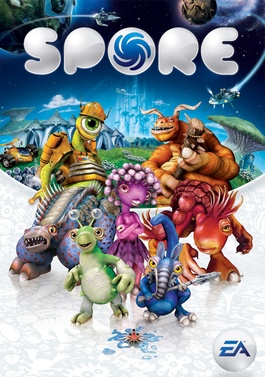 I have a head cold and the antihistamines I took keep have me nodding off. I have three different topics I’d like to talk about and hardly enough energy for one. I’ll go with a topical one: Spore.
 The Galactic Adventures pack is coming out sometimes soon. I wouldn’t know because EA’s marketing isn’t accurate. For the last two months, I’ve seen banners and ads saying it was ‘available now’ and each time I clicked through I ended up at a pre-order page. (Wiki says it came out June 23 – see, this is kinda, sorta topical!)
This is about original Spore though, and my opinion of it can be summed up thusly: Creativity is no panacea for mediocrity. Just because a game is innovative, genre defying, creative, inspired, artistic – whatever synonym you prefer – does not mean it’s a good game. Even if those same elements can turn a good game into an excellent game.
Which leads to the question, ‘Does a game have to be good to be worthy or important?’ No, not at all. Enter the Dragon is a bad film, but it’s the film that introduced American audiences to Bruce Lee and quality martial artist choreography. Before Enter the Dragon, most Hollywood fight scenes were Western style shootouts or akin to Captain Kirk vs. Gorn.
A c-game[1] is a form of media as well as an art form as well as (sometimes) an interactive narrative form as well as (sometimes) a social experience as well as system the user navigates using heuristic devices. The last is what makes a game a game, and when I say a game is good or bad, that’s major element I’m evaluating.
In a number of reviews, I’ve read that Spore is not one but five games. I’d argue that it’s two games: the pre-space age and the space age. The cell, creature, tribal, and civilization stages [2] are a single game and a bad one at that. The goal in each stage is to grow, you can choose to do so violently or not, and the way you implement your goal is by gathering a resource and buying objects. In the cell and creature stage, these are body parts. In the tribal stage, these are clothing, children, and buildings. In the civilization stage, these are vehicles and buildings.
There are many excellent games built around this core concept: gather resources in order to buy a beneficial improvement. In Civilization IV, a strategy game, I try to gather metals, food, and money so I can by buildings. In Diablo, an action RPG, I kill things to gather XP so I can buy powers and abilities.

The early stages of Spore never go beyond the core concept. It’s about as bare bones as you get and the lack of complexity, of even simple give or take, means you can go through these early stages on cruise control.
I’m not the first view the simplicity of the early sections as problematic, but I’ve notices that many believe this decision was made to appeal to casual gamers. The hardcore/casual schism is ridiculous and mostly perpetuated by ‘real’ or ‘hardcore’ gamers who view the mere existence of games that don’t cater to their tastes as a type of sacrilege. Maxis might have ‘dumbed down’ Spore for casual gamers, but I doubt it.
I play casual games, my mother plays casual games, my mother’s friend plays casual games, and my mother’s friends daughter and *her* daughter both play casual games, often together. Nothing they play is as boring as the first four levels of Spore. Games like Bejeweled or Plants vs Zombies are simple, but still very engaging.
Moving on to the Space Age and we find a semi-decent space civ sim, but still not as good as half-a-dozen other games on the market.
The bottom line is that if it weren’t for the creature/building/vehicle creator, this game would have hit the bargain bin a month after it was released.

Problematically, the creation tool isn’t a game, it’s a tool. It’s fun to play around with. It’s also fun to eat dinner, go to a movie, or doodle on my PC tablet, but while it’s nice when fun and games meet, one does not imply the other. There are parts of the creation tool that relate to the game as you design your creature’s body and pick various parts to buy, but in itself, this isn’t a game.
This makes things difficult for me. If I’m judging a game, do I go by the total experience, or just the game? It’s not that unusual a quandary. If I go out to a restaurant, and get a great view of the ocean, watch the chef prepare the entrée while flames leap up around her, and have great conversation with my friend, but the food itself is lousy, how good was the meal? There are people who love the creation tool. (And not just because they can make a giant dickasaurus) I don’t enjoy it, but I can see how it’s unique and interesting and an impressive feat.
A game does not have to be good to be worthy or important. I’m not sure if this is either of those either. No other developers seem interested in exploring a multi-generational game right now and user-end content creation tools haven’t changed. More accurately, Spore is riding a larger trend in letting users create content.
Ultimately, Spore might be an evolutionary dead-end when it comes to gaming.
1 - Computer or console game
2 - It’s inaccurate to suggest that a tribe isn’t a form of civilization. A bit of unintended ethnocentrism there.
 Overlord II – examination
Note: As of this write-up, I’m 4/5ths through the game and about to begin a section called The Last Battle. This review contains spoilers.
The Introduction:
In 2007, Codemasters released a Triumph Studios game called Overlord. It was a third-person puzzle game in which the PC as the titular dark Overlord, gathered a group of minions and enslaved or destroyed the populous of a fantasy setting. The setting itself was a spoof of stereotypical fantasy settings, and the game had many comedic elements.
Despite this premise, the Overlord is ‘the good guy.’ The antagonists of the piece are the seven heroes who slew the previous Overlord and have since become corrupt with power, their particular vices based on the seven deadly sins.
It was an interesting game. Solid puzzles, a fresh idea, and engaging plot made this one of the best games of 2007. At the same time, it could get a little monotonous. I managed to make it through a single play though, but I only finished because I wanted to see the ending. Sometime after the fourth (or was it fifth?) boss battle I got bored with the gameplay.
Overlord II is set several hundred years after the original. The old Overlord mysteriously disappeared after the magical Great Cataclysm and the world is currently ruled by the decadent and magic hating Empire. I suspect a twist ending, but haven’t reached that point yet. I’ll amend this post when I do.
Other than the plot, it’s the same game: You are an Overlord; you use minions to fight and solve puzzles; you collect a variety of resources so you can upgrade your minions, armor and weaponry, and your Netherworld Fortress; and you have mistresses who give you a bonuses and a sex scene. There are a few additions: minions have mounts now, dominating a town makes resource collection easier, and the graphics have improved.
But, is Overlord II as good as its predecessor? Is it better? Is it worth shelling out money if you enjoyed the original?

The Good:
Yes. Yes. And (you guessed it) yes.
Not only is it as good as Overlord, it’s better. For one thing, it’s more puzzle-centric. In the original Overlord, you could slaughter your entire group of minions in a big fight, run back to the spawn pits to get more, and then finish the fight with fresh recruits. In Overlord II, a fight is either of easy or normal difficulty, or it’s a puzzle. If your troops are being slaughtered, it’s because you’re doing something wrong.
Some players might object to this – what’s the use of having 700 brown minions if there aren’t fights that grind them into ground beef? – but a puzzle game ought to reward problem solving and punish you for trying to just muscle your way through combat. It’s far more satisfying to replay an encounter several times until I get that mental click, at which point things become easy, than to scrape through an encounter with 1 HP and all the minions I’ve leveled up and equipped dead.
Overlord II also avoids the monotony of the original game. The puzzles are much more varied; there are only a handful of sections where you guide your minions through a dangerous maze, which happened in Overlord every 30-45 minutes. Overlord II has sections where you possess a minion, usually to sneak around, places where you take control of catapults and war machines, and even places where you steer a ship. These game play shifts are well integrated into the story and gameplay, so they don’t feel like random mini-games.
The ability to control towns is a smart move. Towns provide you with a steady source of money, equipment, and lifeforce. They also feel ‘right’ for an evil Overlord.

The Neutral:
The story isn’t as interesting as the first game. It’s not bad, but at least with the Seven Deadly Sins theme, it felt slightly cohesive instead of a series of unrelated puzzles in different locations. I don’t care about defeating the bad guy because he’s only a face. I don’t care about saving everyone because I’m an evil Overlord. I have no personal stake in the matter as the main character has all the personality of burnt bread (burnt bread in hulking, evil armor.)
It’s supposedly a comedy game, but it’s a weak form of comedy. It’s sort of like a five-year-old coming up to you and doing a silly dance: it’s not so much funny as something you smile at because it’s cute and they made the effort.
So, the minions put random stuff on their head, drink beer, and piss loudly afterwards. Haha? They club baby seals and the elves talk in a California accent while defending all that’s cute and fluffy. Haha?
Part of the problem is that when it comes to books, their ‘spoof’ is dated. In 1996, The Tough Guide to Fantasyland by Diana Wynne Jones, made most of these jokes about elves, dwarves, and other common fantasy tropes, but even then they weren’t all that common. Overlord II is a bit like a comedian making jokes about big-hair, neon green legwarmers, and Flashdance. The tropes it makes fun of are mostly confined to DnD and a handful of cRPGs.
Someone once said, “Most game developers have read one book – Lord of the Rings – and seen two movies – Star Wars and Aliens.” If you’re like this, you probably believe the Overlord series contains barbed satire of the fantasy genre. If you’re like me, you probably wish the jokes weren’t so stale.
I also find it strange that Overlord II insists you be a hero of sorts, yet again. Dungeon Keeper never told you that while you appeared to be crushing everyone around you, you were truly saving the world from a much greater tyranny. This is the second time the series has you playing a dark savior. Why?
I’d rather the main antagonist was a good, pure-hearted soul that I stomped under my rusty, iron boots.

The Bad:
Overlord isn’t a perfect game by any means. If you want cool stuff, you have to spend hours farming for resources. Instead of having fun, you get to run around areas you’ve already visited to kill gnomes or destroy the scenery with your minions yet again. It’s dreadfully boring. If you’re going to make farming mandatory, at least try to make it interesting.
For some reason, there’s a ‘Kill 1,000 gnomes’ quest in your journal. It’s an achievement and unlike the other quests, there’s no benefit to it. Achievements are not quests. They should not be listed in the quest log. Another tedious ‘quest’ is the kill/dominate 100 townsfolk for two of the towns. At least this one has some benefit, as dominated townsfolk produce weaponry.
But again, instead of solving puzzles or fighting things, I waste my time farming. This isn’t WoW, and the game is long enough without this element. Why not ditch the farming aspects altogether?
Like the first game, you have ‘good’ or evil choices. More like evil and less evil, really. There are times when the ‘good’ choices are difficult to make. For instance, I run around an elven commune attempting to dominate everyone as they toss pumpkin bombs and swear up and down they’re not rebelling. The AI has no sense of self-preservation though, and several times the elves toss pumpkin bombs into a group of elves or into their own house and blow the crap out of themselves. After they do this a few times, the game decides that I’ve subdued the village through ‘destruction’ even though I haven’t attacked or harmed anyone.
Lastly, on a politically correct note, this game hates fat people. It’s bizarre. There’s even a cut-scene where the camera lingers on a naked fat man while Gnarl, one of the minions, rants about how disgusting he is. I’d write this off as a writer missing his medication one day, but it’s not an isolated incident.
When I was in college, I knew a few girls who’d lost a large amount of weight and obsessed about fatness. For them, being heavy was equivalent to necrophilia. Parts of this game makes me wonder if some of them might have made it into game development.
